
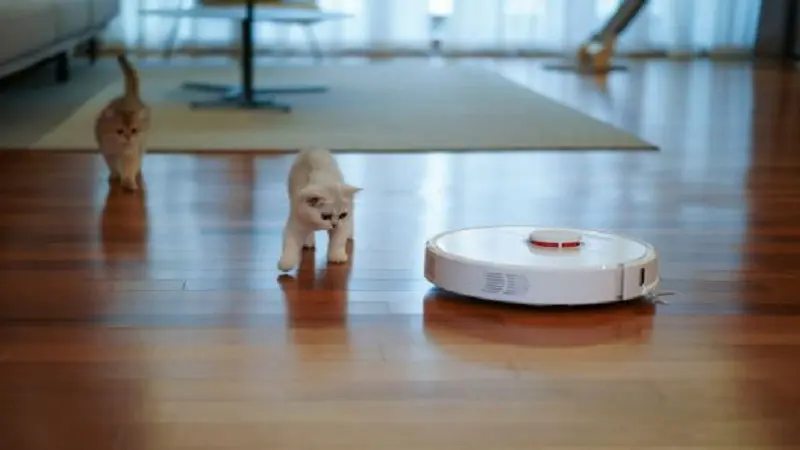
The most successful smart-home technology often performs a difficult balancing act. Behind the scenes, increasingly sophisticated software and processing power are required to make devices faster, more autonomous, and more capable. From the user’s perspective, however, the experience should ideally become simpler.
Robot vacuums are a good example of that contrast. Mapping an unfamiliar home, determining a position within it, planning efficient routes, responding to boundaries, and controlling multiple mechanical systems are complex computational tasks. Yet the homeowner generally wants something much more straightforward: press a button, choose where to clean, and let the robot handle the rest.
bObsweep approaches that challenge from both sides. Its robotic cleaners incorporate navigation technology designed to understand a home quickly, while the company presents those machines with an unusually approachable personality. Underneath that friendly exterior is serious processing technology responsible for making the experience possible.
Bio provides a useful example of how these layers come together.
Mapping a Home While the Cleaning Begins
One of the traditional frustrations with smarter robotic cleaners has been setup. Advanced navigation is valuable, but requiring a device to spend significant time learning the home before it becomes useful can make automation feel like additional work.
Bio uses bObsweep’s QSLAM® – Quantum Simultaneous Localization and Mapping – technology together with LiDAR and real-time computing to take a more immediate approach.
Instead of requiring a dedicated training run or preliminary area scan, the robot builds its understanding of the environment as it operates. Within minutes, it can create a map and identify different rooms, allowing navigation and cleaning to begin as part of the same process.
This matters because mapping is not simply about producing an attractive floor plan inside an app. A useful map becomes the foundation for more purposeful behavior.
Once the home has been mapped, users can customize how Bio interacts with individual areas. Rooms can be divided, combined, and labeled, while cleaning boundaries can be added for spaces where the robot should not vacuum or mop. NoSweep zones can keep it away from cluttered areas, for example, while NoMop zones can protect rugs and carpeted sections when the mopping attachment is in use.
The result is a form of automation that can become more specific to the household. Instead of treating an entire floor as one undifferentiated cleaning space, the robot can respond to the way that particular home is organized.
Real-time mapping also demonstrates an important principle in smart-home design: complexity is most useful when it reduces effort rather than creating more of it. The technology operating underneath Bio may be sophisticated, but its purpose is to make the interaction with the robot feel more direct.
Interestingly, bobsweep Bio omni carries that effort to make robotics feel approachable beyond software and navigation. Even the way the company talks about its machines is deliberately more personal than the language normally associated with household appliances.
Giving the Robot a Personality
For most household appliances, personality is almost irrelevant. A dishwasher is a dishwasher, and a vacuum cleaner is generally expected to remain a tool. Robotic cleaners occupy a slightly different space because they move independently through the home, follow routines, return to their docks, and increasingly interact with users through apps and automated behaviors.
bObsweep has leaned into that distinction from the beginning.
Rather than presenting its robots as anonymous machines identified only by model numbers, the company has traditionally given them names and a more playful identity. The original concept centered around “Bob,” and that personality has remained part of the brand as its product range has expanded.
One of the more unusual details is the inclusion of a “birth certificate” with the robot. It is a small gesture, but it illustrates a much broader branding strategy: make sophisticated household technology feel less clinical and more approachable.
That tone creates an interesting contrast with the engineering underneath the product. A robot may appear friendly and uncomplicated from the outside while simultaneously performing thousands of calculations to determine where it is, where it should move next, and how it should respond to changing conditions around the home.
Treating a robot as something closer to a household companion can also make autonomous technology feel more natural. People already tend to anthropomorphize machines that move independently, particularly devices they see operating repeatedly in familiar spaces. Giving those machines names simply embraces a behavior that often happens naturally anyway.
For a smart-home brand, this can be valuable because technical sophistication does not always need to be communicated through technical language. Consumers may appreciate advanced navigation and processing without wanting to understand every algorithm or component responsible for it.
A personable brand identity helps translate that complexity into something easier to engage with.
But the friendly presentation should not obscure the amount of engineering required to make autonomous behavior feel effortless. Fast mapping, responsive navigation, motor control, sensor management, and efficient power use all depend on the processing hardware operating inside the robot.
That is where another layer of bObsweep’s technology becomes important: the computing platform responsible for turning mapping data and software instructions into real-time movement.
Serious Processing Behind the Friendly Exterior
Modern robotic cleaners cannot afford long delays between sensing something and responding to it. A robot moving through furniture, walls, rugs, and other obstacles must continually process information and adjust its behavior almost immediately.
To support this kind of operation, bObsweep has used NXP’s i.MX RT1052 crossover processor in its robotic-cleaning platform. The chip is designed to combine high-performance processing with the deterministic responsiveness expected from a microcontroller, giving embedded devices the ability to handle demanding tasks while still reacting quickly to real-world inputs.
For a robot vacuum, that combination is particularly useful.
Navigation involves multiple processes taking place at once. The robot may be interpreting LiDAR data, updating its position on a map, determining the next movement, controlling motors, monitoring sensors, and managing battery consumption simultaneously. Those processes cannot simply happen eventually; many of them need to happen in real time.
The ability to process that information quickly helps make features such as fast mapping and purposeful navigation possible. Instead of pausing to interpret its surroundings, the robot can continuously update its understanding of the environment as it moves.
In practical terms, this is the technological layer that helps turn sophisticated software such as QSLAM® into physical behavior inside the home.
The Technology That Makes Autonomy Feel Effortless
The value of a high-performance processor is not simply that it can handle more calculations. In a robotic cleaner, what matters is how those calculations translate into smoother movement, faster reactions, and more efficient use of power.
NXP’s i.MX RT1052 helps support that balance. Its architecture is designed for responsive, real-time control while also delivering the processing performance required by more complex embedded applications. That makes it well suited to devices that need to combine navigation, sensor input, movement, and power management without adding noticeable delays.
For bObsweep, this creates a concrete technological foundation for features that might otherwise appear purely software-driven. QSLAM® can calculate position and map the environment, but the underlying hardware has to process that information quickly enough for the robot to act on it in real time.
The same applies to efficiency. A robot vacuum operates within the limits of a battery, so every system has to balance performance with power consumption. Processing hardware that can manage demanding tasks efficiently helps preserve that balance while allowing the robot to remain responsive.
This is where the premium side of the technology becomes more tangible. Advanced positioning is not based only on visible design or a longer feature list. It can also come from the quality of the engineering underneath the surface.
For the user, that engineering ideally disappears into the experience. The robot maps quickly, follows boundaries, adjusts its movement, and completes its routine without making the complexity behind those actions obvious.
That is arguably the best outcome for smart-home technology: sophisticated systems doing difficult work in a way that feels simple.
Smart Enough to Be Useful, Approachable Enough to Live With
Taken together, QSLAM®, NXP-powered processing, and bObsweep’s playful brand personality reveal three different sides of the same product philosophy.
One is about intelligence. The robot needs to understand its environment quickly and navigate it with purpose.
Another is about engineering. Real-time processing and efficient hardware are required to make those software features work reliably in the physical world.
The third is about the relationship between people and technology. By giving its robots names, personalities, and even “birth certificates,” bObsweep makes a highly technical product feel less intimidating and more familiar.
That combination matters because the smart home is ultimately a human environment. People do not experience processors, mapping algorithms, and sensor systems separately. They experience whether a device is easy to set up, whether it moves intelligently, whether it responds predictably, and whether it feels natural to have around.
The future of robotic cleaning will undoubtedly involve more powerful hardware and more sophisticated software. But technical progress alone does not guarantee a better experience.
The most compelling products may be the ones that can hide that complexity behind intuitive behavior and a more approachable identity. In that sense, the smartest robot is not necessarily the one that feels the most technical. It is the one whose technology works so naturally that living with it feels easy. See more