
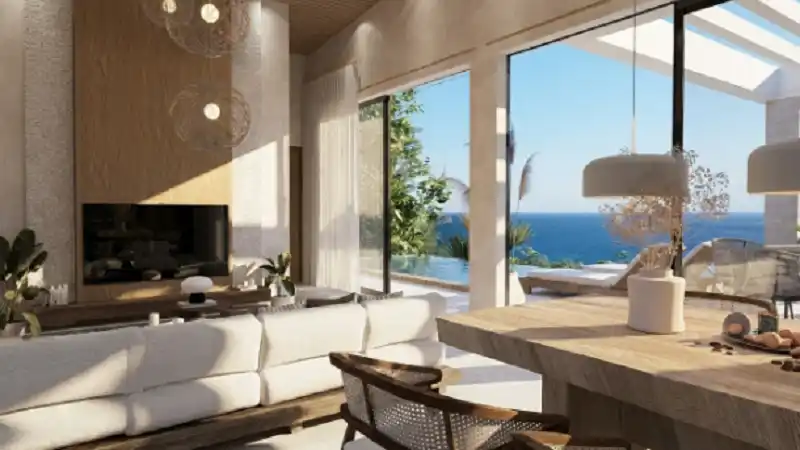
People use the word “luxury” constantly, in architecture, in interiors, in every second real estate listing you read. But most of the time, what they are actually describing is expense. A high price tag. An imported material. A brand name on a fitting.
For us, luxury has always meant something quieter than that. It is about how a space makes you feel the moment you step inside, and how it continues to make you feel six months after you have moved in. At Adoani Studio, we approach this not as a style question, but as an experiential one. And that distinction changes everything about how we design.
Luxury Is Not What You Add
The first instinct most clients bring to a high-end project is additive. More marble. More ceiling height. More of everything that signals quality.
But the homes that feel genuinely luxurious are never the ones with the most inside them. They are the ones where everything that remains has earned its place. That is a harder standard to meet — and a far more rewarding one to work toward.
The Discipline of Subtraction
When you fill a space, you are hiding decisions inside other decisions. When you strip it back, every choice becomes visible:
- The proportion of the ceiling
- The weight of one material against another
- The way a threshold is resolved between two spaces
- The consistency of a shadow line across a facade
In minimal architecture, there is nowhere to conceal an unresolved detail. A room that feels calm and complete is almost always the result of a long process of editing — of trusting that what is left, if chosen well, is enough. Restraint, in this sense, is not a style preference. It is a discipline.
Three Conditions That Define Minimal Luxury
Over the years working across architecture and interior design in Bali, we have come to think of minimal luxury as requiring three things — all present at once. If any one is missing, the space does not quite arrive.
The Space Must Feel Generous
Not large — generous. A room with resolved proportions and well-managed light can feel expansive at 40 square metres. A room with poor proportions will feel cramped at twice the size. Generosity in architecture is not about square footage. It is about how a space breathes.
The Materials Must Be Honest
By honest, we mean chosen for what they genuinely are — not for what they signal. When we design minimalist spaces, we look for materials that have real character:
- Natural stone that shows its grain
- Timber that deepens and ages over time
- Concrete that does not pretend to be something else
- Plaster surfaces that carry depth without pattern
When materials are used this way, a space develops a quality of presence that no surface treatment can replicate.
The Details Must Disappear
This is the hardest condition. In a truly resolved space, you do not notice the detailing. You simply notice that everything feels right — the junction where the floor meets the wall, the way a ceiling plane extends into a covered terrace, the consistency of a reveal. These things are not dramatic, but their absence is felt immediately.
Designing for the Bali Environment
Working as a Bali architect gives this question a very specific dimension that purely urban architecture lacks.
Here, the environment itself is the luxury. The sea, the quality of morning light, the warmth of the air at night — these are not things you can replicate indoors. They are the site’s greatest asset. So the first question on any designer villa in Bali is never about style. It is: what does this site already offer, and how do we build something that gives that the space it deserves?
The architecture should serve the landscape. Not compete with it.
Light — The First Design Decision
We think about light before we think about walls. Before layouts, before materials, before almost anything else.
In Bali, the tropical sun is intense. Direct exposure from midday can make even a beautifully designed space feel oppressive. So light here is never about maximising openness — it is always about control.
How We Manage Light
- Deep overhangs that cut the harsh afternoon glare without closing the view
- Louvred screens that filter the western light while keeping the sense of openness
- Skylights positioned to bring in soft morning light without heat gain later in the day
- Oriented openings that frame the view without exposing the interior to direct sun
When light is managed with this kind of care, a space develops a quality of calm that is difficult to explain but impossible to miss. You simply breathe differently inside it.
The Material Palette We Trust
We work with a tight palette — not out of habit, but because we have learned to trust these materials completely. More importantly, we have learned that introducing a fifth or sixth material is almost always a sign that something else has not been resolved yet. A proportion. A transition. A spatial relationship that needs more thought rather than more material.
Timber
Warm, organic, and alive. It changes over time — deepening in colour, softening at the edges. Used on ceilings, wall panels, outdoor screens, and furniture, it brings a quality no synthetic material can replicate.
Stone
Used in different states across the same project — rough and raw externally, refined and smooth internally. The same material, two expressions. That continuity between outside and inside carries enormous weight.
Concrete
Honest and structural. Not hidden behind cladding or disguised with surface treatments. When detailed well, it carries a presence that is very hard to achieve with anything else.
Plaster and Lime Wash
Surfaces that absorb light rather than reflect it. Quiet, deep, and completely settled. They make a room feel as though it has always been there.
Inside and Outside — One Continuous Experience
In tropical residential architecture, the relationship between interior and exterior is not a stylistic choice. It is a fundamental decision about how the home will be lived in.
A home that treats the interior as primary and the exterior as secondary has misunderstood the opportunity entirely. The goal is continuity.
What That Looks Like in Practice
- The same floor level reading from the living room through to the terrace
- Glass walls that retract fully, leaving the opening completely unobstructed
- A pool positioned so that from inside, it reads as part of the room — not something beyond it
- Covered outdoor areas that are deeply shaded and genuinely usable throughout the day
- Landscaping used architecturally — to create enclosure, rhythm, and shade
The In-Between Spaces
The covered loggia, the semi-open pavilion, the shaded zone between pool and living room — these transitional spaces are among the most important in the entire home. They are where light softens, temperature adjusts, and movement naturally slows before continuing deeper into the house.
In every project we design in Bali, these spaces are considered from the very first sketch. Never added at the end.
Architecture That Does Not Date
There is a practical argument for this approach that is often overlooked.
Spaces designed around light, proportion, and honest materials simply do not date. A room built around a surface trend begins to feel tired within a few years. A room built around fundamental qualities has no expiry date.
This matters deeply in a place like Balii, where many of the homes we design as Adoani Architects are long-term investments — properties that need to feel extraordinary not only on completion day, but ten and fifteen years later. Minimal luxury is timeless, not by coincidence, but because it is built around things that never change:
- The quality of natural light in the early morning
- The warmth and honesty of real materials
- The human need for space that feels calm and resolved
- The relationship between a well-designed home and its landscape
To Clients Who Ask for “Something Simple”
When a client says they want something simple, we always pause. Because what they almost always mean is something quite different, they want a space that feels effortless. Calm. Natural. Easy to be in.
Effortlessness is one of the most demanding things to achieve in architecture.
The homes we are most satisfied with the projects that clients walk into and immediately exhale are the result of enormous amounts of thought that is now completely invisible. Every detail is resolved so carefully it no longer draws attention to itself. Every material chosen until the palette holds together without anything competing for attention.
That invisibility is not an accident. It is the entire goal. When the architecture steps back and you are left with nothing but the experience of being in a calm, completely resolved space — that is minimal luxury. That is what we work toward on every project we take on. See more