
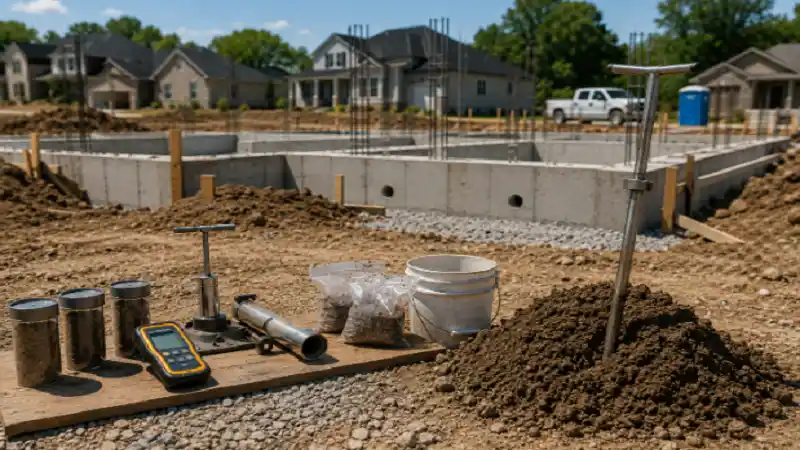
Here is something that surprises a lot of first-time builders: by the time the concrete gets poured, one of the most critical decisions has already been made. And most people never even realize it happened.
The decision I am talking about is whether or not to test the soil. Not the kind of casual “poke a stick in the ground” check, but a proper geotechnical investigation that tells you what you are actually building on. It sounds dry. It sounds technical. But skip it, and you may spend the next decade watching your investment slowly pull itself apart.
I have seen it happen. A homeowner puts up a beautiful addition on the back of their house, saves money by cutting the site investigation, and within three years the new section has visibly shifted away from the original structure. The gap between the old wall and the new one was nearly a quarter of an inch. That is not a cosmetic problem. That is a structural one, and fixing it cost more than the original investigation would have by a factor of ten.
The Ground Is Not Just “Ground”
This is the mental shift that matters most going into any project. Soil is not a passive, uniform surface you pour concrete onto. It is a living, variable material with its own characteristics, behaviors, and failure modes. Two plots of land that look completely identical from the surface can behave in opposite ways under a load.
What geotechnical testing actually evaluates comes down to a handful of core properties. Bearing capacity tells engineers how much weight the soil can hold before it begins to compress or fail. Moisture content reveals how saturated the ground is and how that changes seasonally. Compaction data shows whether the particles are packed densely enough to provide a stable base, or whether they will settle further over time. Permeability determines how water moves through the soil, which matters enormously for drainage design.
Beyond those basics, some tests measure things like the Atterberg limits, which define the point at which certain soils shift from solid to plastic to liquid behavior depending on their water content. This is particularly important on clay-heavy sites, where the ground literally expands and contracts with the seasons.
Professionals conducting field investigations typically bring out soil moisture testing equipment along with compaction tools, augers for sampling at depth, and penetrometers to measure resistance at different levels below the surface. The data gathered informs every structural decision that follows.
So Why Do People Skip It?
Usually it comes down to two things: time and money. A basic geotechnical report for a residential site runs somewhere between five hundred and three thousand dollars depending on the complexity of the terrain and how many borings are required. To someone already juggling a construction budget, that feels like an easy line to cut.
But consider what you are comparing it to. Foundation repair on a settled or cracked slab regularly runs between five thousand and twenty thousand dollars or more. Underpinning a failing foundation, which involves driving steel piers deep into stable ground after the fact, can cost twice that. The geotechnical report that seemed expensive is suddenly looking like the cheapest thing on the whole project.
There is also a permitting angle that often gets overlooked. Many municipalities now require a geotechnical assessment before they will issue a building permit for new construction. In those jurisdictions, skipping the test is not even an option. But in areas where it is not required, the absence of a mandate sometimes gets mistaken for an absence of necessity.
What Problem Soils Actually Look Like
Not every site is a problem. But the ones that are tend to be problems in very specific, predictable ways. Knowing what to watch for makes it easier to understand why certain sites need more investigation than others.
- Expansive clay soils push and pull with moisture changes, making them among the most damaging materials a foundation can sit on in humid or variable climates.
- Organic soils and peat compress easily under load and are generally unsuitable as bearing material without significant remediation.
- Loose sand and fine-grained silt can liquefy under seismic activity, turning essentially into a fluid under the right conditions.
- Fill material is perhaps the most common problem on urban and suburban sites. Previously disturbed earth may be unevenly compacted, may contain debris, and behaves unpredictably under structural loads.
Fill soil is especially relevant in older neighborhoods and former industrial areas. What looks like a level, grassy lot may be sitting on decades of fill that has never been properly compacted. A probe tells you that. A visual inspection does not.
The Connection to Concrete Work
Here is where soil testing ties directly into the next phase of the project. The properties of the ground underneath determine the specifications of the concrete above it. A site with soft subgrade or elevated moisture levels typically requires a thicker slab, additional steel reinforcement, or both. Good, stable, well-compacted granular soil might support a leaner foundation design that saves money on materials.
That connection runs both ways. Soil data shapes the concrete design. And then the concrete itself needs to be verified through testing before and during the pour to ensure it will actually meet those specifications. This is where concrete testing becomes part of the same integrated quality chain. Slump tests confirm workability. Air entrainment checks protect against freeze-thaw damage. Compressive strength tests on cylinders verify the mix will hit the structural targets the engineer specified.
When geotechnical and concrete quality checks are treated as part of the same process rather than separate boxes to tick, the result is a building that performs the way it was designed to. When either one gets skipped or rushed, you are essentially hoping the design assumptions were conservative enough to cover whatever you missed.
When to Schedule the Investigation
The right time is before the design is finalized. Ideally, before you even purchase the land.
Soil data gathered during site selection gives you real negotiating leverage. If a site has problematic ground conditions, the remediation cost is a legitimate factor in the purchase price. Some buyers walk away from sites that require deep piering or extensive fill replacement. Others negotiate a discount that accounts for those costs. Neither outcome is possible without information.
At minimum, the investigation should be complete before an engineer produces the foundation design. Foundations cannot be properly sized, typed, or specified without ground data. Starting design work without it means making assumptions, and assumptions in structural engineering carry real consequences.
For Homeowners and Smaller Projects
If you are a homeowner overseeing a renovation or a smaller addition, you might feel like geotechnical investigation belongs in the world of large commercial developers. It does not. A small addition still needs a foundation. That foundation still sits on soil. The rules of physics do not change based on project size.
Even if your municipality does not require a report, hiring a geotechnical engineer for a basic site assessment is a reasonable investment. You get documentation of site conditions, a defensible foundation design, and the peace of mind that comes from knowing rather than guessing.
That last part is worth more than people give it credit for. Construction involves enough unknowns on its own. The condition of the ground beneath your feet is one unknown you can actually resolve before you start.
Putting It Together
Soil testing is not glamorous. It does not show up in renovation magazine features or make for compelling social media content. But it is the step that determines whether everything that comes after it will hold.
Good construction is about controlling variables, and the ground is one of the biggest variables there is. Understanding it before you build is not a luxury. It is the baseline for doing the job right. See More