
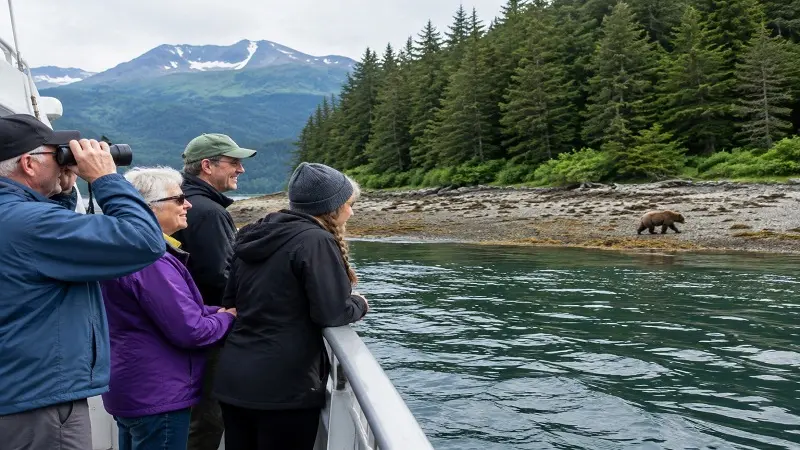
Four hours sounds like plenty of time. It isn’t. Once you’ve cleared the gangway, found your meeting spot, and allowed a buffer before all-aboard, a cruise passenger may have closer to two and a half hours of real bear country. That’s the math every traveler should do before picking an icy strait Hoonah Coastal Brown Bear Tour.
Growing up in Hoonah, I learned early that bears keep their own calendar. They don’t care about a ship’s schedule. Chichagof Island holds roughly one to two brown bears per square mile, among the densest numbers anywhere, but density alone doesn’t put one in front of your camera. Tide, salmon runs — the time of day do that work.
So what separates a good short-stop outing from a frustrating one? Mostly the small stuff. Van size. Where the driver heads first. Whether the guide knows which creek the bears favored this week. And you’ll want to settle those questions well before you sail, not while you’re standing on the dock.
Why a 4-hour port stop changes how you pick a brown bear tour in 2026
A couple from Ohio steps off the ship at 7:30, coffee still warm, sure they’ve got four hours of bear country ahead. By the time they find the meeting spot and sort out the van, the clock has already eaten 40 minutes. That’s the math nobody prints in the cruise brochure.
My grandmother used to say the tide doesn’t care about your plans. Neither does the ship’s horn. Anyone choosing an icy strait hoonah Coastal Brown Bear Tour for a short stop has to plan backward from the all-aboard time, not forward from the gangway.
Counting the real minutes between gangway and all-aboard
Start with the posted all-aboard time and subtract 30 minutes. That’s your safety cushion. Now take off 15 to 20 minutes for the walk to the meeting point and boarding.
- Four-hour stop: roughly 3 hours remain, so a 2-hour tour fits with room to spare.
- Tender or late arrival: shave another 30 minutes off.
- Three-hour tour: only works if the ship docks early and stays long.
Why timing matters more than tour length
Longer isn’t better. Bears keep their own schedule, mostly dawn, dusk, and wherever the salmon are running in the creeks of this wild island. A tight, well-timed outing beats a long one that sends you sprinting back to the dock.
So ask the operator one blunt question: what’s your record getting guests back before the ship leaves?
Where the bears actually are: habitat, season and salmon on Chichagof
Bears go where the food is. Everything else is noise. On Chichagof, brown bears gather in the places that feed them, and a good icy strait hoonah Coastal Brown Bear Tour is built around those spots, not around a postcard view.
Salmon streams, tidal flats and old-growth forest
Three habitats matter most:
- Salmon streams and creeks: Bears fish the shallow riffles, and eagles line the banks waiting for scraps.
- Tidal flats and estuaries: At low tide, bears graze sedge and hunt along the shoreline. Check your tide table.
- Old-growth forest edges: This is the bears’ cover, and where they slip in and out of sight.
Chichagof holds roughly one to two bears per square mile (the island’s wild reputation is earned). That’s a density you won’t find at Katmai or in Yellowstone’s grizzly country. But it’s still wilderness. Bears don’t keep a schedule.
July and August versus the shoulder months
July and August are peak salmon weeks, so the odds are best. Streams fill, and bears feed in the open for hours. Why does that matter for a short stop? Because you’ve got little time to wait around.
May, June and September can still pay off. Spring bears graze green sedge along the shore, and fall bears fatten up before the snow. Sightings run thinner, though, and weather shifts fast.
No honest guide promises a bear. Ask how they read the streams instead.
Small van or 40-person bus: what you’ll actually see and photograph
Ever tried to photograph a brown bear through the back row of a packed coach? Most people who’ve done it say the same thing. They saw the back of someone’s head. And a blurry brown shape.
On an icy strait hoonah Coastal Brown Bear Tour, group size shapes everything. A van carrying 10 or fewer guests means every seat is a window seat. A 40-person bus can’t say that, and it can’t pull over on a narrow forest road when a bear steps out of the alders either.
Window seats, stop flexibility and guide knowledge
Here’s what I’d tell my own aunties to look for. Three things matter most:
- Window seats: Ask how many guests ride per vehicle. Ten or fewer gives you a clear shot at the shoreline, the muskeg and the salmon streams.
- Stop flexibility: Small vans can halt for a bald eagle, a Sitka deer, or a bear on the tideline. Big buses stick to fixed stops.
- Guide knowledge: A guide raised here knows which creek the bears favor by the week, and how the weather and tides move them. That’s not something a script teaches.
Chichagof is wild country, with roughly one to two bears per square mile. Density helps. A guide who reads the habitat helps more.
Photographers, take note. Small groups give you minutes to adjust your settings, not seconds. That’s the difference between a keepsake and a snapshot.
Know before you book: weather, mobility, wildlife odds, and getting back to the ship on time
Chichagof Island holds roughly one to two brown bears per square mile. That’s the densest count anywhere, and it still doesn’t mean a bear walks out on schedule. My family has lived beside these bears for generations, and I’ll tell you straight: the odds are good, never promised.
Here’s what to check before you pay a deposit on any icy strait hoonah Coastal Brown Bear Tour.
- Weather: Rain is normal here. Pack a waterproof shell and layers. Wet days often bring bears down to the creeks, so don’t cancel over drizzle.
- Mobility: A van-based outing with short walks suits most knees and backs. Ask how long the walks are and whether there are steps.
- Wildlife odds: Salmon runs peak in July and August, and that’s when bears gather along the streams. Eagles, deer, and otters fill the gaps.
- Ship timing: With a 4-hour stop, you want a 2-hour or 3-hour outing, never longer.
And that last one matters most. Ask the operator two questions: how early do they return, and what’s their record? A good guide watches the clock the way a fisherman watches the tide.
Small groups of ten or fewer also move faster than a full bus. Fewer people to load, fewer to wait on.
A short port day rewards the traveler who plans backward. Start with the ship’s all-aboard time, subtract the walk to the meeting spot and a generous cushion, and what’s left is the real window for bears. That number, not the brochure length, should decide the tour.
Habitat matters just as much. Bears gather where salmon run and tides expose the flats, and a guide who has watched those spots for decades will beat a bigger vehicle every time. Eight or ten people in a van can stop when a bear shows up. Forty on a bus usually can’t.
So the best icy strait hoonah Coastal Brown Bear Tour for a four-hour stop is the one that’s honest about odds, small enough to move freely, and firm about getting you back to the gangway early. Sightings are never promised. Good preparation still tilts them your way.
Your next step is concrete. Pull up your cruise itinerary today, write down the exact all-aboard time, and ask any operator you’re considering how they handle the return trip before you reserve a seat. See more