
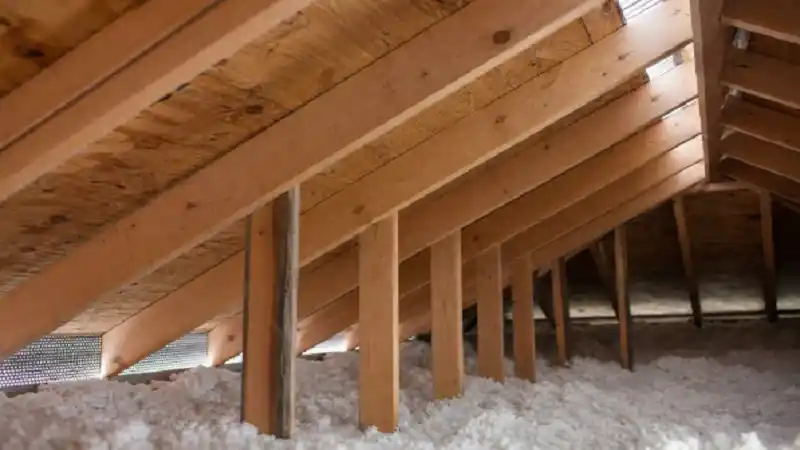
Asphalt shingles can fail a decade early without a single visible problem on the roof surface. The culprit is usually hidden in the attic, where summer temperatures in under-ventilated El Dorado Hills homes routinely exceed 150 degrees Fahrenheit, a threshold at which asphalt shingle binders begin to oxidize and shorten service life by years. Roof Geeks, an El Dorado County roofing contractor, evaluates attic ventilation as part of every roofing assessment because the condition of the roofing system above and the airflow below are inseparable.
The Ventilation Variable Most Property Owners Never Consider
A roofing system without adequate attic ventilation degrades prematurely regardless of shingle grade or installation quality, making roof ventilation in El Dorado Hills the single most consequential variable in determining how long a roof actually lasts. Most property owners focus on shingle brand or contractor workmanship, and both matter, but neither compensates for a thermally stressed, moisture-laden attic cavity working against the assembly from the inside.
El Dorado Hills sits between 500 and 1,200 feet elevation in the Sierra Nevada foothills, producing higher UV index values and faster radiant heat absorption than the Sacramento valley floor. Many residential neighborhoods, including older sections of Bass Lake Hills and tracts predating Serrano and Blackstone, were built in the 1980s and 1990s when soffit vents were commonly installed without interior baffles, reducing net free area to a fraction of code-compliant levels. The wet-dry cycle produced by 30 to 35 inches of annual precipitation, concentrated between November and March, compounds thermal stress by cycling moisture through an already heat-damaged roofing assembly.
What Attic Ventilation Actually Does to a Roofing System
Attic ventilation is not a comfort feature. It is a mechanical requirement that directly governs the thermal and moisture conditions inside a roofing assembly, determining whether the system reaches its rated service life or fails a decade early.
Heat Buildup and Shingle Degradation
Without adequate soffit and ridge vent balance, trapped heat radiates into the underside of the roof deck. At 150 to 160 degrees Fahrenheit, asphalt shingle binders oxidize, and the fiberglass mat becomes brittle. Granule adhesion fails within 8 to 10 years rather than the 25 to 30-year manufacturer-specified window.
Moisture Accumulation and Deck Rot
Warm interior air rising into an under-ventilated attic contacts cold sheathing surfaces, and the resulting condensation drives wetting cycles that produce OSB delamination and dry rot. Insulation pushed against unbaffled soffit vents blocks intake airflow entirely, leaving the deck substrate exposed to chronic moisture even when ridge venting is present. Roof Geeks’ attic ventilation services include baffle inspection and correction as a standard component of deck assessment because ventilation correction is a prerequisite for dry rot repair.
The Net Free Area Equation
Net free area is the actual open area through which air moves, measured in square inches. The code-compliant standard requires 1 square foot of net free area per 150 square feet of attic floor space. An imbalanced system with excess exhaust capacity and insufficient intake creates negative pressure that pulls conditioned air from the living space into the attic, short-circuiting airflow and increasing HVAC load. Net free area should be calculated against actual attic floor dimensions before any ventilation correction is specified.
Frequently Asked Questions
What are the signs that a roof has inadequate attic ventilation?
Curling, cupping, or premature granule loss on asphalt shingles indicate heat buildup in the roof assembly. Attic temperatures above 130 degrees Fahrenheit during summer, visible moisture staining on the underside of the roof deck, and ice dams at the eaves all point to ventilation failure rather than installation error.
Can ventilation problems be fixed without replacing the entire roof?
In most cases, ventilation can be corrected without a full tear-off. Adding or enlarging soffit vents, installing a continuous ridge vent, or clearing blocked baffles are all standalone repairs. OSB sheathing that has delaminated requires partial deck replacement before any ventilation upgrade will hold, but that work does not obligate a property owner to replace the entire roofing system.
What is the difference between passive and active attic ventilation?
Passive ventilation uses the stack effect and wind pressure to move air through soffit intake vents and out through ridge or box exhaust vents, with no mechanical components. Active ventilation uses powered attic ventilators, which require a properly sized intake to avoid depressurizing and drawing conditioned air from the living space. A properly balanced passive system is sufficient for most residential roofing systems across the greater Sacramento region.
How do attic insulation and ventilation interact?
Adding blown-in insulation without first installing baffles to maintain the intake airflow channel at the eaves is one of the most common causes of ventilation failure in El Dorado County’s older housing stock. Blocked soffit vents eliminate the intake side of the ventilation circuit, making ridge vents ineffective regardless of their net free area.
Does proper attic ventilation reduce energy costs?
Properly ventilated attics in El Dorado Hills can reduce cooling-season attic temperatures by 30 to 50 degrees Fahrenheit, directly reducing HVAC runtime during the region’s prolonged dry summers. Energy savings accumulated over a 25-year roofing system lifespan often exceed the original cost of the ventilation upgrade.
About Roof Geeks
Roof Geeks is a licensed roofing contractor serving residential and commercial properties throughout the Sacramento metropolitan area, with a focus on El Dorado Hills and the surrounding El Dorado County communities. The company installs and repairs asphalt shingle, metal, tile, and flat roofing systems, and performs attic ventilation evaluations as part of its roofing work. Their office is located at 4261 Sunset Lane, Suite 201, Shingle Springs, CA 95682. See More