
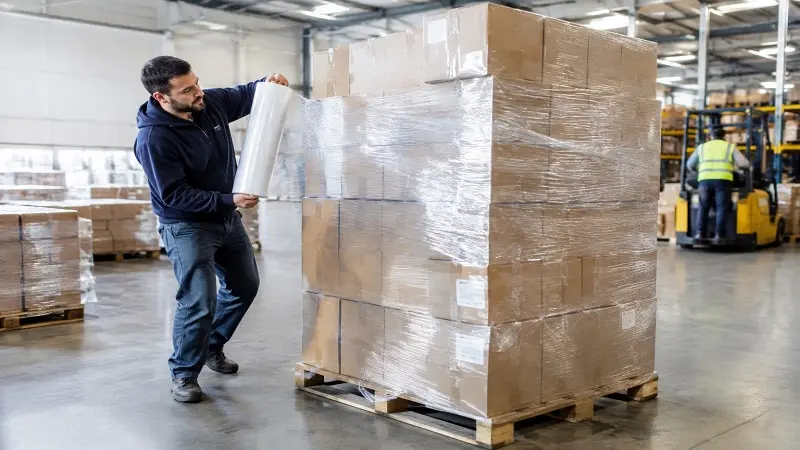
Dust doesn’t announce itself. Neither does humidity. By the time a manager spots the gray film on top of a pallet or the soft, bowed corners on the bottom cartons, the damage has been building for weeks.
A large plastic wrap roll is the cheapest defense most warehouses own, and plenty of crews still use it like they’re only getting a load to the dock. Wrap it tight, slap on a tail, done. That works for a two-day trip. It doesn’t work for a pallet that sits in the back rack for ninety days (or longer, if the forecast was off).
Here’s what 22 years on the floor teaches you: stored goods fail from the top — the base first, not the sides. Loose film, thin gauge, and gaps at the bottom let in more trouble than a leaky roof ever will. And once moisture gets into corrugated, you’re not fixing it. You’re writing it off.
So the real question isn’t whether to wrap. It’s whether the wrap you’re buying is built for storage.
Why dust and moisture wreck stored pallets faster than most managers expect
A pallet of paper goods sits in a back corner for six weeks. Nobody touches it. When the crew pulls it, the bottom cartons are soft, the top layer is gray with grit, and the whole load leans. That’s not a freak event. It happens in warehouses every month.
What a slow leak of humidity does to cartons and product
Corrugated drinks moisture like a sponge. A carton that holds 32 ECT strength on day one can lose a third or more of its stacking strength once humidity climbs — and stays there. Slow damage. No drama, just soft walls and crushed corners weeks later.
Dust is the quieter problem (and the one managers blame last). It settles into carton flaps, clings to bubble pouches and foam, and ruins white retail packaging before anything ships. A properly wrapped load keeps both out. A large plastic wrap roll in a heavy-duty gauge, applied with real overlap, gives you a sealed skin around the whole load.
Where film fails first: corners, tops, and gaps at the base
Film doesn’t fail in the middle. It fails at the edges, and here’s where to look:
- Corners: sharp carton edges cut thin film. Corner boards fix that.
- Tops: wrappers skip them, so dust and drips settle right in. Add a cover sheet and wrap over it.
- Base: a loose first wrap leaves a gap at the pallet deck. Anchor it to the pallet, then go three turns low.
Miss any of those and moisture finds the opening. It always does.
Picking the right large plastic wrap roll for storage, not just shipping
Shipping film and storage film aren’t the same job. A large plastic wrap roll that holds a pallet together for three days of trucking can still let dust and damp creep in over three months on a shelf. Most buyers miss that.
Stretch wrap roll vs. shrink film: which one seals out dust
Stretch film clings to itself and hugs the load by tension alone. It’s quick, it’s cheap, and it works well on furniture, boxed goods, and cardboard cases. Shrink film is different. Heat pulls it tight into a sealed skin (a heat gun or tunnel does the work), which closes gaps that stretch wrap leaves at seams and corners. For long-term dust and moisture control, shrink wins. For anything you’ll unwrap and rewrap often, a stretch wrap roll is the practical pick.
Gauge, width, and core: matching roll specs to heavy-duty plastic wrap for shipping and long-term storage
Three specs decide most of it.
- Gauge: 80 gauge handles light cartons and covers. Go 100 gauge or thicker for sharp corners, heavy furniture, and stacked storage.
- Width: 18 inches suits hand wrapping. Use 20 inches for bigger loads, and 30-inch machine rolls for high volume.
- Core: Extended handles save wrists on hand rolls. Machine cores need to fit your dispenser, so check before ordering by the case.
Match the film to how long the load sits. Short hauls tolerate thin film. Storage doesn’t.
Wrapping technique that actually keeps moisture out
Why do so many wrapped pallets still come out of storage damp? Because the film touched the load but never sealed it. A large plastic wrap roll only works as a moisture barrier when the pattern is right.
Top cover, base anchor, and overlap: a shop-floor wrap pattern
Start low. Anchor the film to the pallet board with two full turns, then spiral upward. Overlap each pass by 50% so there’s always a double layer — keep the stretch around 150% on a machine, or firm hand tension if you’re wrapping by hand.
- Two to three turns at the base, catching the pallet deck.
- Spiral up with half-width overlap.
- Run the film over the top edge and across the cover, since water pools there first.
- Spiral back down and tuck the tail into a wrap layer. Don’t leave it flapping.
Skip the top cover, and you’ve wrapped a sponge.
Cutting film waste while still sealing the load
More turns doesn’t mean more protection. Most damp loads we see have eight or ten loose wraps instead of four tight ones (a common shop-floor habit, and an expensive one). Pre-stretched heavy-duty film in a 20-inch width often seals better with fewer revolutions.
- Match gauge to the load: lighter film for boxed goods, heavier for sharp-cornered furniture.
- Use corner boards or a sheet of cardboard on sharp edges so the film doesn’t tear.
- Weigh a few wrapped pallets. Anything past 3 to 4 pounds of film is probably overkill.
Tighter, not thicker. That’s the fix.
Beyond pallets: plastic wrap for furniture storage, moving, and mixed materials
Roughly 1 in 3 furniture damage claims in storage trace back to scuffs and moisture, not drops. Film alone stops a lot of that. A single large plastic wrap roll, 20 inches wide, covers a sofa in about 10 minutes.
Large cling wrap for furniture and how it pairs with foam, bubble, and cardboard corners
Wrap the piece, don’t suffocate it.
Leather and finished wood need a layer of padding or paper underneath, because trapped moisture clouds the finish (a mistake that shows up weeks later). For plastic wrap for furniture storage, build it in layers:
- Pad edges with foam sheets or cardboard corner boards.
- Add bubble wrap on glass, legs, and trim.
- Lock it all down with stretch wrap, overlapping each pass by half.
Skip the tape on the furniture itself. It leaves residue. Use it on the film’s tail only.
When a large plastic wrap roll isn’t enough and what to add
Film has limits. It won’t stop a forklift fork, a crushed corner, or a flooded floor.
- Heavy items: add strapping or a moving blanket under the film.
- Long-term storage: use a sealed cover or poly sheeting plus a desiccant pack.
- Fragile pieces: box them in double-wall cardboard first.
So what’s the rule of thumb? Film holds things together. Padding protects them. Use both.
Dust and moisture don’t announce themselves. They show up weeks later as warped cartons, spotted labels, and a returns pile nobody budgeted for. The fix is rarely fancy.
A large plastic wrap roll does its best work when the film matches the job: enough gauge to resist tearing at the corners, a full top cover, and a base wrap that locks the first turns to the pallet. Skip any one of those and humidity finds the gap. Over-wrap everything, and film waste quietly eats the savings. The managers who get this right treat wrapping as a pattern, not a habit, and they check it the same way they check a count.
Not every load can rely on film alone. Long-term storage in damp buildings, or loads with exposed metal and raw paper, call for a top sheet or a desiccant pack under the wrap.
So here’s the next step.
Pull three stored pallets from your slowest-moving aisle this week, cut one open, and check the bottom layer of cartons for soft edges or dust. Whatever you find will tell you exactly what to change in your wrap spec. See more