
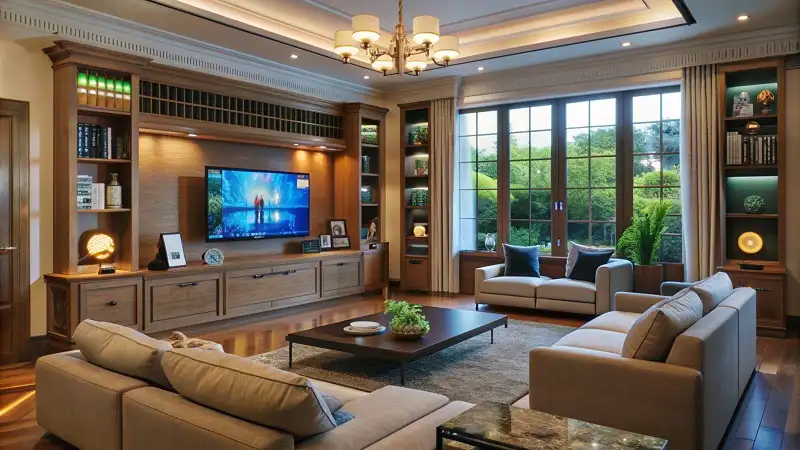
You have spent months curating a gorgeous, open-concept living space. The last thing you want is a giant black box and a sprawling tangle of cables ruining your careful aesthetic choices. This is the primary conflict for modern audiophiles. You want an immersive, cinema-grade audio experience, but you absolutely refuse to compromise your minimalist interior design with bulky equipment.
Fortunately, the days of choosing between beautiful rooms and beautiful sound are over. The demand for seamless, high-end entertainment is skyrocketing among design-conscious homeowners. In fact, the global home theatre market was valued at USD 12.36 billion in 2024 and is projected to reach USD 40.58 billion by 2030, according to Grand View Research.
Centralized Hub Architecture
When planning a high-end audio system, the first question is usually about the wires. How do you centralize AV equipment to eliminate cable clutter in a main living space? The answer lies in removing the equipment from the living room entirely.
Centralized hub architecture takes the traditional AV receiver and relocates it to a hidden, dedicated space. This might be a ventilated utility closet, a basement AV rack, or custom-built cabinetry. This modern AV receiver acts as a hidden command center. Instead of pointing a plastic remote at a stack of blinking lights under your television, you control volume, streaming services, and audio zones seamlessly through a mobile app on your smartphone or tablet.
To support this invisible setup, you need to look for specific features in a modern AV receiver. Network capabilities are mandatory, allowing the unit to communicate with your home’s Wi-Fi network for app-based control and streaming. You also need robust integration options that play nicely with smart home ecosystems like Control4 or Crestron.
Achieving this seamless look is rarely a DIY project. Professional installation of home theater audio equipment helps ensure receivers, speakers, and other components are properly integrated into the room and connected to the central system. Professional integrators can route the necessary high-bandwidth cabling through walls, position speakers for the room’s layout, and conceal equipment where appropriate, leaving the living space clean without sacrificing audio performance.
Exploring Your Speaker Options
Once the receiver is tucked away, you have to address the speakers themselves. What are the best ways to hide surround sound speakers in a modern, open-concept living room? You might assume that achieving high-resolution surround formats like Dolby Atmos or DTS:X requires large, imposing floor-standing equipment.
That simply isn’t true anymore. Modern speaker engineering offers multiple ways to fill a room with sound without filling it with boxes. You generally have two premium choices for a clutter-free environment: architectural speakers and truly invisible speakers.
Here is a quick breakdown of how different speaker types impact your room’s aesthetic and installation needs.
| Speaker Category | Visual Impact | Installation Complexity | Ideal Application |
|---|---|---|---|
| Floor-Standing | High (Visible cabinets) | Low (Plug and play) | Dedicated, isolated theater rooms |
| Architectural | Low (Flush grilles) | Medium (Cutting drywall) | Open-concept living spaces |
| Invisible | Zero (Completely hidden) | High (Plastering over) | Ultra-minimalist luxury homes |
Architectural Speakers: In-Wall and In-Ceiling Solutions
Architectural speakers refer to in-wall and in-ceiling units designed to preserve clean interior design lines. They mount flush with the room’s surfaces. The only visible element is a low-profile, micro-perforated grille that can be custom-painted to match your exact wall or ceiling color.
Many people wonder if hidden speakers compromise on sound quality or bass response compared to traditional floor-standing models. While early generations of in-wall speakers lacked depth, today’s premium models feature specialized acoustic enclosures built directly into the wall cavity. These engineered back-boxes control the air volume behind the driver, producing tight, punchy bass and remarkable clarity that rivals standalone cabinets.
Ceiling placement is also inherently ideal for modern surround formats. Dolby Atmos relies heavily on immersive, three-dimensional height channels to make sound feel like it is moving above you. In-ceiling architectural speakers are actually the optimal choice for delivering this overhead audio, creating a realistic soundscape of rainfall, passing airplanes, or echoing concert halls.
Truly “Invisible” Speakers: Sound Behind the Drywall
If even a painted grille is too much visual clutter for your minimalist space, you can take the concept a step further. Completely “invisible” speakers represent the pinnacle of hidden audio technology. These flat-panel units are installed directly into the framework of the wall or ceiling, right behind the drywall or plaster.
The mechanics behind this technology are fascinating. Once installed, the speaker is covered with a thin layer of finishing compound and painted or wallpapered over. The speaker uses specialized exciters to vibrate the actual surface of the wall, turning the wall itself into a massive acoustic radiator that pushes sound into the room.
This is the main difference between standard architectural flush-mounts and invisible applications. While architectural speakers have visible grilles, invisible speakers offer a totally seamless finish with zero visual footprint.
“The luxury home-installation bracket is traditionally where hidden speakers reside, but… you might be seeing — or not, as the case may be — more of these sound systems cropping up in more regular homes.”
According to a recent review by TechRadar, these concealed units have rapidly evolved. They now deliver a true “wall of sound” that is more than capable of handling serious hi-fi or home theater setups. You get audiophile-grade performance without a single speaker in sight.
Conclusion
High-end, cinematic surround sound and minimalist interior design can coexist beautifully with the right strategy. You no longer have to sacrifice the clean, open feel of your living space just to enjoy the immersive depth of a Dolby Atmos movie soundtrack.
An invisible cinema relies on three specific pillars. First, you must centralize the AV receiver in a hidden location to manage the system and eliminate cable clutter. Second, you swap bulky cabinets for architectural or invisible speakers that blend right into the drywall. Finally, you apply precise room calibration to ensure those hidden components deliver breathtaking, audiophile-grade performance.
Upgrading your home’s audio potential should be an exciting process, not an aesthetic compromise. By leveraging modern hidden technologies and professional integration, you can transform your living room into a world-class entertainment space while keeping your design vision perfectly intact.